Office Clearance in Richmond upon Thames

Office clearance in Richmond upon Thames for businesses that need desks, chairs, storage units, paperwork, IT equipment and general workplace contents removed with care. We handle clearances for offices, studios, shared workspaces and other commercial premises, helping you clear surplus items, reduce clutter and prepare rooms for reuse, refurbishment or handover. Our service is designed to be practical, orderly and straightforward, with attention to segregation, loading and responsible disposal.
We cover a wide range of office clearance needs, from a single room that needs emptying to larger multi-room environments with a mix of furniture and equipment. Where items are suitable for reuse or recovery, they can be separated from waste streams to support better material handling. Where goods are no longer fit for use, they are removed efficiently so the space can move on to its next stage without unnecessary delay.
If you are planning a clearance, a simple written brief helps us understand what needs removing and how access works. List the main item types, mention any heavy or awkward pieces and let us know if lifts, stairs or loading restrictions apply. You can also set out any priorities such as keeping certain items in place, separating archive material or scheduling work around other contractors. Start with a clear scope and the rest can be arranged more smoothly.
What office clearance can include
An office clearance can cover a broad mixture of contents, and the work often needs to balance speed with care. Typical items include desks, meeting tables, filing cabinets, shelving, task chairs, reception furniture and breakout-room pieces. Depending on the property, there may also be compactors, screens, partition panels, small appliances or boxed materials that need to be sorted before loading. The aim is to remove what is no longer required while leaving the premises tidy and ready for the next step.
Clearances also vary by how the workspace is used. A professional office may have open-plan furniture, while a smaller premises may hold a more eclectic mix of storage, samples and equipment. In either case, a careful approach helps protect the building and the remaining fixtures. Where items have to be carried through narrow corridors or shared entrances, we plan the movement so that the process is orderly and less disruptive to the rest of the property.
To make the work easier to scope, these are the kinds of details that are useful to mention first:
- the rooms or areas to be cleared
- the main furniture and equipment types
- any items that must stay on site
- access points, parking or loading constraints
- whether the work is part of a move, refurbishment or closure
Furniture, storage and fitted items

Much of an office clearance is about handling furniture and storage in a way that is efficient but not rough. Large desks, conference tables, cupboards and shelving often need to be broken down or manoeuvred carefully before removal. When fittings are fixed in place, the work may involve removing detached components first so that the remainder can be carried out without damage to walls, doors or flooring. This is particularly useful in premises that are being prepared for decoration or reconfiguration.
Storage items can also require different handling from standard furniture. Filing cabinets may contain paper that needs sorting, while locker banks and archive units may have mixed contents or keys that have been misplaced. Where relevant, the clearance can separate identifiable materials so they can be treated correctly. This helps keep the process organised and supports better decisions about what is retained, recycled or taken away as waste.
For spaces with a large amount of office furniture, it is often best to think in zones. Workstations, storage, communal areas and reception spaces may each need slightly different handling, especially if some items are to be reused elsewhere. If you are comparing options, our office clearance service sits alongside other property-emptying work and can be shaped around the layout of the premises rather than treated as a one-size-fits-all job.
Equipment, paperwork and sensitive contents
Office clearance is not only about bulky furniture. Many premises also contain printers, monitors, computers, telephone units, cables, stationery, archived files and boxed records that need attention. Some of these items can be moved as standard waste, while others need more careful handling because they are reusable, recyclable or sensitive. A sensible clearance process keeps these categories separate and avoids mixing material that should be treated differently.
Paper records are a common concern in commercial premises, particularly where documents have built up over time. The right approach depends on whether files are to be retained, archived, shredded or removed with other contents. We can work to the instructions provided and keep particular areas or boxes aside where necessary. Clear labelling helps, especially if you have a mix of items that must remain and items that are ready to go. That simple step can save time during the clearance itself.
Electronic equipment also deserves consideration. Items such as screens, towers and peripherals may contain parts that need separate treatment from general office waste. If you are preparing for a handover or refurbishment, it is worth identifying the devices that stay on site and the ones that should be removed. Waste removal can cover the wider disposable material, while a clearance keeps the full room-by-room picture in view.
Planning access and working around operations
Commercial premises often have more complicated access than a domestic property, so office clearance works best when the route is considered in advance. That might mean checking stair access, lift availability, loading points, opening hours or shared building rules. Where a workplace still has staff present, the clearance can be organised to keep corridors usable and to avoid unnecessary interruption to day-to-day activity. Good planning makes the physical work simpler and keeps everyone clear on what will be moved.
If the clearance is part of a move or a phased exit, it may be sensible to tackle the rooms in sequence. Reception, meeting areas, storage rooms and general workspaces can each be handled at the right point rather than all at once. This gives you more control over what is removed and what remains available for continued use. It also makes it easier to identify items for reuse, donation or disposal before anything is loaded.
Where the job needs to be coordinated with other work, such as decorators, contractors or building management, a brief plan is helpful. It should cover timings, access arrangements and any items that must stay untouched. If you are gathering options for other room-by-room services too, the flat clearance page can be a useful comparison for understanding how a clearance is structured when rooms need to be emptied carefully rather than simply collected in one load.
Reuse, recycling and disposal choices
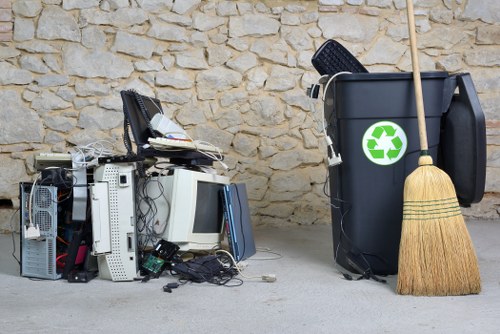
Many office clearances include items that are not all headed for the same destination. Some furniture may still have a useful life, while other pieces are worn out, damaged or no longer suitable for circulation. Sorting these categories properly matters, because it allows practical items to be separated from material that should be recycled or disposed of. A tidy loading sequence and sensible sorting on site can make the overall process more efficient.
Recycling opportunities depend on what is present. Metal components, wood-based furniture, cardboard, plastics and certain electrical items may each follow different handling routes. Rather than treating everything as mixed waste, a structured clearance gives more room for correct segregation. That approach is especially useful where the premises contain a range of contents from different departments, since not all rooms will produce the same kind of material.
For businesses that want to understand how disposal choices affect a project, our recycling and sustainability page explains the general approach we take to separating usable and recyclable material. In practice, the best outcome usually comes from deciding early what is staying, what can be reused and what should be removed. That clarity saves time on the day of the clearance and helps the work move in a more orderly way.
Pricing factors and quotation details
Office clearance prices are usually shaped by the practical details of the job rather than by a simple room count. The amount and type of furniture, the presence of electrical items, the ease of access and the distance items need to be carried all affect the level of work involved. A small suite with straightforward access will naturally differ from a larger workplace with multiple floors, secure entrances or substantial fitted storage. Clear information allows the quote to reflect the actual task.
It also helps to mention any items that require special handling. Heavy cabinets, broken chairs, stacked archive boxes, dismantled workstations and mixed rubbish all influence the time and method involved. If certain pieces need to remain on site, say so from the outset so that the clearance scope is accurate. For broader planning, the pricing and quotes page gives a sensible starting point for understanding how quotations are prepared and what details are most useful.
For an accurate quotation, a concise description is often enough to begin with: the property type, approximate volume, access conditions and any time limits. If you are ready to talk through the job, please request a quotation or send the details for review. A clear scope produces a clearer response, and that usually makes it easier to organise the clearance in the right sequence.
Office areas, special rooms and hybrid spaces
Not every workplace looks the same, and office clearance often has to deal with more than a row of desks. There may be meeting rooms with larger tables, reception spaces with display furniture, staff kitchens with small appliances or storage rooms packed with mixed items. A practical clearance plan takes account of each of these areas separately so the work can be handled in a controlled order. That matters when rooms serve several functions or when some contents remain in use.
Hybrid spaces are particularly common in smaller commercial premises, where workstations, records, personal effects and stock may all be stored in one location. In those settings, it helps to separate the material into groups before removal begins. If a room contains both furniture and household-style contents, the clearance can still be organised sensibly, but it benefits from early identification of what belongs with the office contents and what should be dealt with another way. Separation first is often the simplest route to a cleaner result.
Where the clearance forms part of a wider property project, the business waste removal page is useful for understanding how non-furniture material can be dealt with alongside office contents. The combined approach can be helpful when the workspace contains a blend of equipment, packaging, archived material and ordinary commercial waste that all needs to be removed without confusion.
How a straightforward clearance is organised
For most office clearance jobs, the work is easiest when it follows a simple order. The items to be removed are identified, the access route is confirmed and the loading area is kept clear where possible. Furniture is then taken out in a sequence that matches the room layout, which reduces unnecessary lifting and helps prevent congestion in hallways or entrances. This method is useful in both compact offices and larger premises with several departments.
As a customer, you do not need to sort every item into perfect categories before asking for help. What matters most is giving a realistic overview of the space and pointing out anything that needs special treatment. That might include fragile equipment, locked storage, fixed joinery, lifts with size limits or materials that must not be mixed with the rest. If you need a separate page for property contents too, house clearance offers a comparable overview of how a clearance can be structured when multiple rooms and mixed contents are involved.
Two practical habits make the whole process easier: first, keep important documents and personal items separate before the work starts; second, tell us which spaces are in active use so that we do not disturb them. Those are small steps, but they make a meaningful difference when a workplace has a lot of moving parts. Simple preparation usually leads to a cleaner, calmer clearance.
About Richmond upon Thames

Richmond upon Thames is a borough in south-west London known for its unusual blend of riverside landscape, historic town centres and extensive open space. The River Thames shapes much of its geography, with stretches of towpath, embankment and floodplain framing settlements such as Richmond, Twickenham, Teddington and Barnes. The borough includes parts of the former royal landscape associated with Richmond Park, one of London’s largest enclosed green spaces, as well as other protected areas that give the district a more spacious character than many inner-London locations. Its built environment is equally varied, ranging from Georgian terraces and Victorian streets to later commercial and civic buildings. Richmond Green, the area around Richmond Bridge and the riverside walk all contribute to a strong sense of historic continuity, while Twickenham’s long association with rugby and the Thames-side settings around Kew and Hampton add further layers of identity. The borough also contains well-known cultural and heritage places, including Marble Hill House and Orleans House Gallery, together with local shopping streets, theatres, cafés and community venues that help sustain a lively everyday atmosphere. Although it sits within Greater London, Richmond upon Thames often feels distinctive because of its mix of water, parkland and townscape. That combination has shaped how the borough developed over time and remains visible in its streets, landmarks and public spaces today.
Furniture disposal and final room clearing

Sometimes an office clearance needs to be followed by a final pass to deal with remaining pieces that were not part of the original load. That might include awkward furniture, broken items found at the end of a room, or small bits of storage that were missed during an earlier phase. A careful final sweep helps make sure the space is left in the condition expected and avoids leaving isolated items behind that later cause delay or confusion.
Furniture disposal is often the last stage of a clearer plan. Once the main desks, chairs and cabinets have been removed, smaller pieces can be assessed and handled in the right way. If some items are reusable, they should not be mixed with damaged or obsolete furniture. Where everything is ready to go, the work can be completed in an orderly sequence so the room is left neat and ready for the next occupier, contractor or internal team.
When you are ready to move forward, a brief message with the property type, the main item list and access information is usually enough to start the quotation process. Ask for a quotation today and include any date constraints if you already have them. If you would like to see how related clearance work is described, the furniture clearance page provides a useful overview of how individual items and larger furniture groups can be removed as part of a broader plan.